
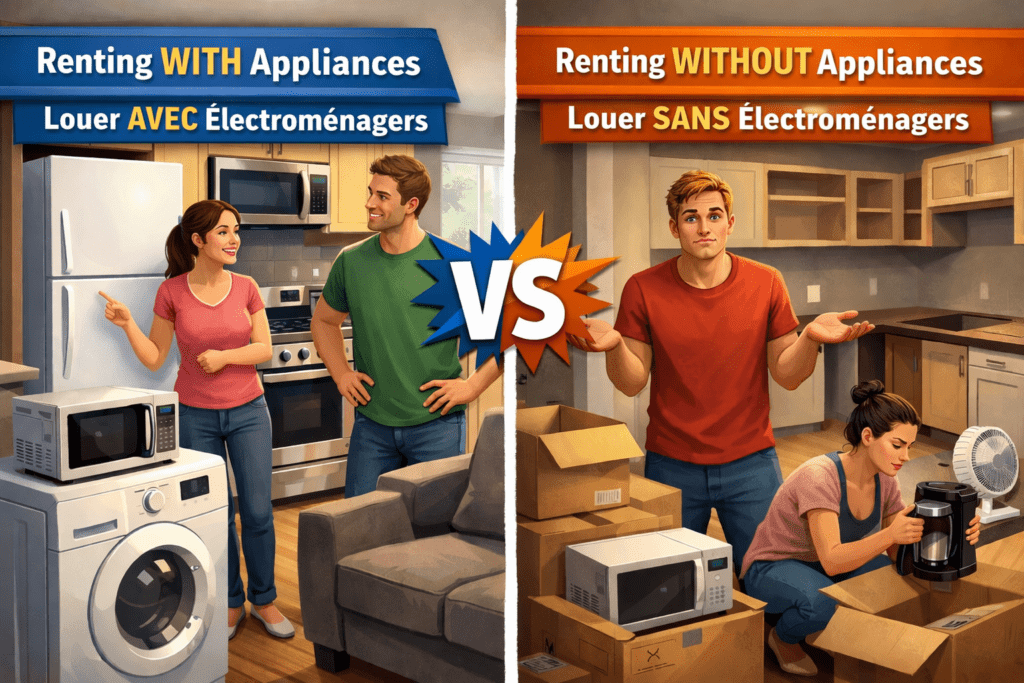
Renting with or without appliances in Quebec the real pros and cons for landlords
One of the most common decisions landlords face is whether to rent a unit with appliances included or to rent it without them. There is no one size fits all answer. It depends on your target tenant, your unit type, and how hands on you want to be with maintenance.
The key is to understand the tradeoffs clearly so you can choose the option that fits your building and your business model.
Why including appliances can help you rent faster
Including appliances usually improves the value proposition for a tenant. For the same rent, a unit that includes a fridge, stove, dishwasher, washer, and dryer often feels easier and cheaper to move into. That convenience can translate into more interest and faster renting, especially in markets where tenants expect inclusions.
This is especially true for one and two bedroom units, where the tenant pool often includes students, young professionals, and early stage families who may not own appliances yet.
Even when you include appliances, your rent still has to reflect market value. If the unit is priced too high, appliances will not magically fix that. They simply increase perceived value within a reasonable price range.
Less moving damage and fewer risky installations
There are also practical risk reductions when you supply certain appliances.
When tenants move large appliances, walls and door frames can get damaged. Including appliances reduces that moving in and out friction.
Installation risk is another big point. Dishwashers are not always plug and play. They involve plumbing and often electrical work. If installed poorly, they can leak and cause major damage. Washer hookups can also leak if hoses are not secured properly.
Dryers have their own risks. If the venting is not properly connected and exhausted outside, humidity and lint can build up and contribute to indoor air quality issues and mould conditions over time.
This is why some landlords choose a middle option. They include the hardest items to install and let the tenant bring the rest.
The biggest downside is more maintenance calls
The more you include, the more points of failure you create. That is the tradeoff.
If appliances are included in the rent, landlords are typically responsible for maintaining and repairing them, subject to what the lease says and normal wear and tear.
And the reality is that many tenants do not maintain appliances the way owners do.
Dishwashers are a classic example. Many people do not know there is a filter that should be cleaned periodically. Over time, this can lead to water sitting at the bottom of the dishwasher and performance issues.
Some washers also have filters that need periodic cleaning. Certain models are more sensitive and will throw error codes when maintenance is ignored. That can turn into extra calls, extra visits, and more small repairs.
So including appliances can mean higher rent and faster leasing, but it can also mean a heavier maintenance workload.
Renting without appliances is simpler but can take longer
Renting without appliances is often simpler operationally. Fewer inclusions means fewer repair requests and fewer arguments about what is and is not covered.
The downside is that it can reduce your tenant pool and slow down leasing, depending on the unit type.
One and two bedroom units can be harder to rent without appliances because convenience matters more to many tenants in that demographic. They may choose a comparable unit that includes appliances even if it costs a bit more.
Larger units like three bedrooms and up often attract more established households who sometimes already own appliances, but that is not always true. Some families still want inclusions. The difference is that the expectations are more mixed and the market segment is wider.
If you rent without appliances, you may have to wait longer for the right tenant or adjust pricing slightly to compensate for the extra effort the tenant must make.
A smart compromise many landlords use
Some landlords include only the dishwasher, and sometimes the washer and dryer, because these are the hardest and riskiest to install. That lowers leak risk and reduces improper venting issues.
Then the tenant brings their own fridge and stove.
This approach can reduce maintenance exposure while still offering a strong value proposition and limiting installation risk.
How to decide what works best for you
Here is a practical way to choose.
If you want to rent faster and target convenience focused tenants, include appliances
If you want fewer maintenance calls and a simpler operation, rent without appliances
If you want to reduce installation risks, include the dishwasher and laundry set and let tenants bring the kitchen basics
If you include appliances, document their condition at move in and be clear in the lease about what is included
And remember one final truth.
Maintenance is part of being a landlord. No matter what type of property you own, real estate is not truly passive. The goal is not to eliminate maintenance. The goal is to choose the kind of maintenance you are willing to manage.
Sources and useful links
https://www.cmhc-schl.gc.ca/consumers/renting-a-home/i-am-renting/maintenance-repairs
https://educaloi.qc.ca/en/capsules/responsibilities-of-landlords/
https://www.quebec.ca/en/housing-territory/renting/rights-and-obligations-of-the-lessor-and-lessee
https://www.corpiq.com/en/news/701-draft-a-lease-agreement-with-confidence-20-best-practices-to-avoid-mistakes-.html
https://www.quebec.ca/en/housing-territory/healthy-living-environment/finding-and-eliminating-mould-from-your-home
https://www.canada.ca/en/health-canada/services/publications/healthy-living/addressing-moisture-mould-your-home.html
https://www.tal.gouv.qc.ca/en/the-dwelling/urgent-and-necessary-repairs